
Most enterprise AI can only reach one of the three kinds of knowledge an organisation holds: the documents. The structured facts in your databases and the relationships between people, contracts and clients usually stay out of reach – which is why AI can answer simple questions but not the connected ones that drive decisions. The fix has less to do with the model you choose and more to do with your knowledge architecture.
When organisations invest in AI, they focus on the questions they want it to answer. What they underestimate is how much the quality of those answers depends on what the AI can actually reach.
Most enterprise AI runs on a surprisingly thin slice of what an organisation knows. It can search documents, find relevant paragraphs, and answer anything that happens to be written down in a file someone uploaded. What it usually can't do is join the dots: tell you how three of your key accounts connect to a supplier showing signs of financial stress, trace the dependencies that make one client's departure disproportionately risky, or pull the exact contractual term you need without also surfacing three that nearly match.
This is not a failure of AI. It is a failure of knowledge architecture – and it’s fixable.
The 3 types of knowledge your organisation holds
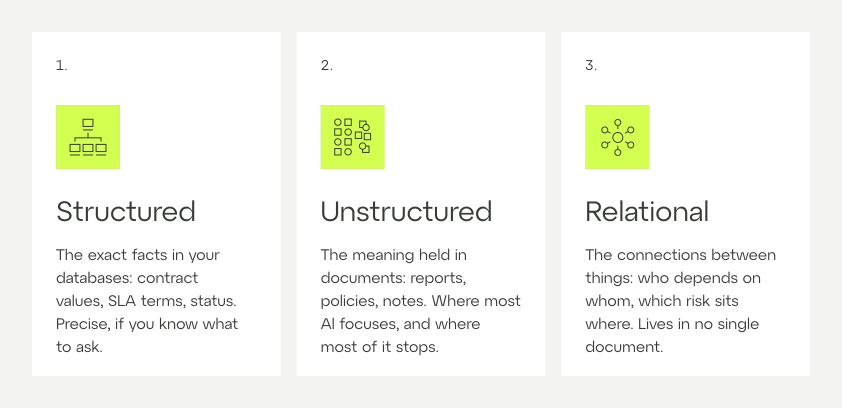
Every organisation holds three types of knowledge, and most AI implementations access only one of them.
The first is structured knowledge: the records, numbers, and facts stored in databases. Contract values. Client names. SLA terms. Compliance statuses. This is precise and queryable, but only useful when you know exactly what you are looking for.
The second is unstructured knowledge: the meaning stored in documents. Reports, policies, proposals, research, meeting notes. This is where most AI systems focus their efforts, and where most stop. Semantic search has made it possible to find relevant documents by meaning rather than keyword, which is a genuine advance over traditional search. But documents alone do not capture the full picture of what an organisation knows.
The third is relational knowledge: the connections between things. Which clients depend on which suppliers. Which regulatory obligations link to which contracts. Which people hold relationships that create either value or risk. This knowledge lives in no single document. It exists only in the network of relationships between entities.
The organisations that will get the most from AI are the ones that make all three types of knowledge accessible, not just the easiest one.
Why most implementations miss it
Classic retrieval-augmented AI, the kind that searches a corpus of documents, handles unstructured knowledge reasonably well. It struggles with structured knowledge, because exact values need exact lookups, not semantic approximations. And it largely ignores relational knowledge, because relationships are not captured in documents at all.
The result is an AI that can find relevant passages but cannot reason across them. It can tell you what a policy says, but it can't tell you which clients, contracts, and teams are affected by a change to that policy. It can surface a document about a key contact, but it can’t show you the network of relationships that makes that contact's departure a material risk.
For simple question-and-answer use cases, this limitation does not matter much. For the complex, multi-step questions that actually drive business decisions (where the answer depends on connecting information from multiple systems and sources) it matters enormously. Analysis of agentic retrieval systems consistently shows significantly higher accuracy on these types of complex queries compared to single-step document search.
What it looks like when AI has all three
Consider a question a senior decision-maker might genuinely ask: "Our main contact at a key client has just left. What is our exposure?"
An AI with access only to documents might return a contract, some email threads, and a general client brief. Useful fragments, but not a coherent answer.
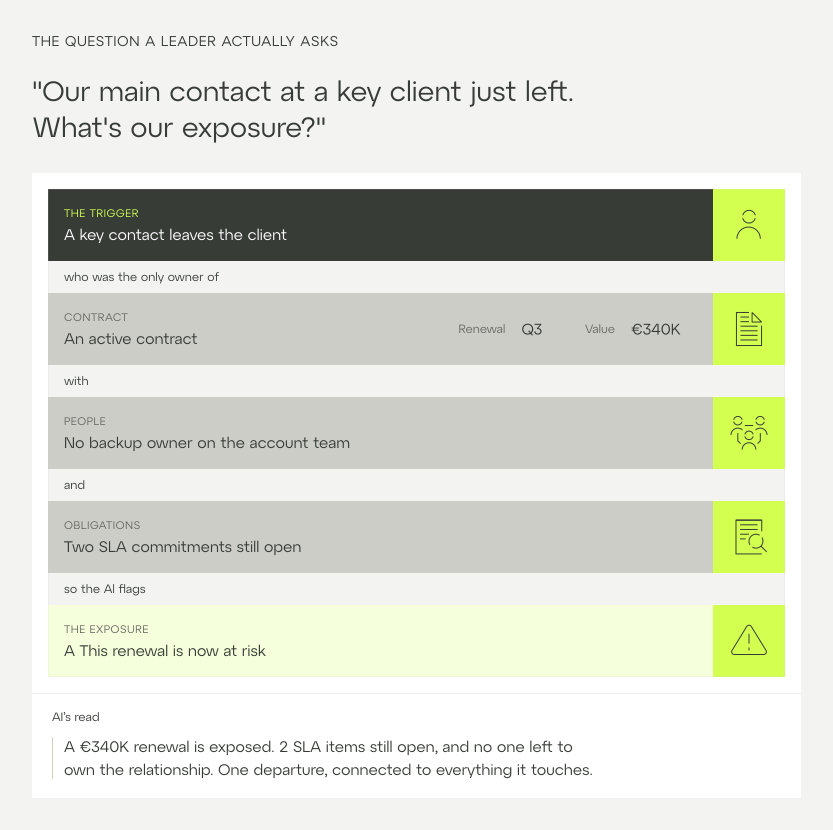
An AI built on a proper knowledge architecture does something different. It identifies every active contract linked to that client and checks their value and renewal timeline. It maps the relationships between the departing contact and others in the account. It surfaces any known dependencies or service commitments. And it connects those threads into a coherent picture of exposure - not because it is smarter, but because it has access to the relational structure that connects the facts.
This is the difference between AI that searches and AI that understands. The technology gap between those two outcomes is smaller than most people think. The architecture gap is significant.
The knowledge infrastructure question
The implication for organisations building AI is direct: the knowledge infrastructure matters as much as the model you choose. A well-configured large language model sitting on poorly structured, siloed, or incomplete knowledge will produce confident-sounding, unreliable answers. That erodes trust. Once trust erodes, adoption stalls regardless of how capable the underlying AI is.
Getting this right means thinking about knowledge in terms of all three types before a platform is selected. What structured data does the organisation hold, and is it accessible? What documents exist, and are they in a processable state with meaningful metadata? Where do the important relationships between entities live, and how are they currently captured?
These are not questions a technology vendor can answer. They require someone inside the organisation to think seriously about what institutional knowledge actually looks like, where it lives, and what it would take to make it genuinely accessible to AI.
Your AI is only as smart as what it can access
The competitive advantage most organisations are chasing is not really about which AI model they use. Models are commoditising rapidly -- the gap between leading options narrows with every release cycle. What does not commoditise as quickly is the knowledge organisations have accumulated over years: the contracts, relationships, processes, decisions, and hard-won expertise that constitute institutional intelligence.
The organisations that will lead in AI over the next three years will not necessarily be the ones with access to the most powerful models. They will be the ones whose knowledge infrastructure is genuinely ready - structured, connected, and accessible in a way that lets AI reason across it rather than just search through it.
Your knowledge is your competitive advantage. The question is whether your AI can actually access it.
About the author

Christian Pedersen
Chief AI Officer at emagine
Christian Pedersen is a technology leader at emagine who turns AI innovation into real business value. He built a 40+ person, globally distributed, remote-first technology organisation from the ground up, overseeing everything from infrastructure to AI engineering. He leads with a product-centric mindset, aligning technology solutions with C-suite objectives.