
Most AI retrieval problems are invisible. The system returns something. It looks relevant. But the answer is off. And nobody knows why.
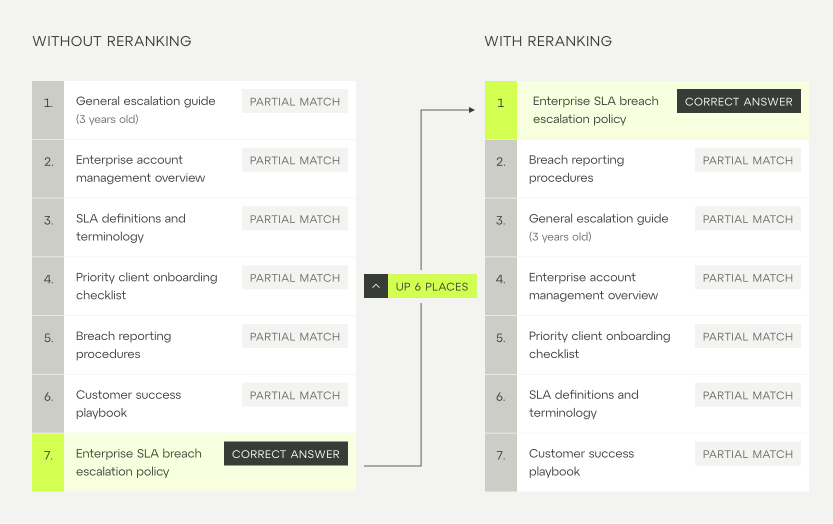
Here’s a scenario that happens more often than vendors admit. An employee asks your AI assistant about the escalation process for enterprise clients in breach of their SLA. The system retrieves dozens of passages from across your knowledge base. The first result mentions escalation. The second covers enterprise accounts. The third references SLA policies. The AI synthesises them confidently and produces an answer.
The answer is wrong. The correct procedure (updated eight months ago) was sitting in a passage buried further down the list.
This isn't a language model failure. The model reasoned accurately from what it was given. This is a retrieval precision failure. And it is the most common class of AI quality problem in enterprise deployments.
What actually happens when your AI answers a question?
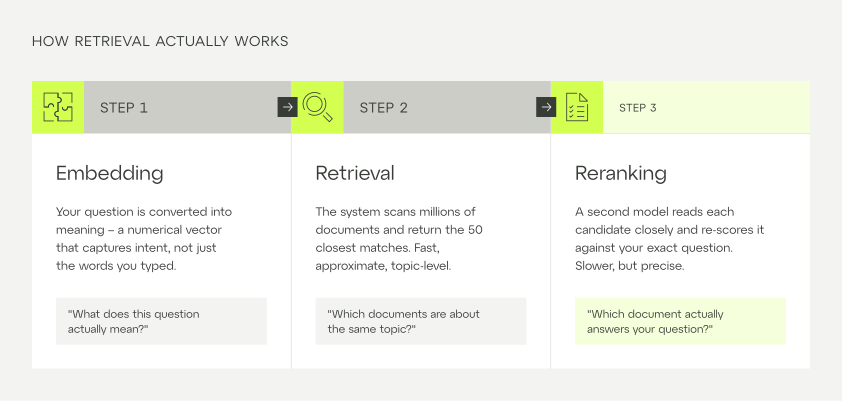
When your AI returns an answer, several distinct things happen. Most organisations treat them as a single “search” step. They are not, and the gaps between them are where quality problems live.
First, your question is converted into meaning. Embedding models translate language into numerical vectors. Think of it as assigning a GPS coordinate to every sentence, where similar ideas cluster together on the same map. “The agreement expires in Q2” and “The contract ends in the second quarter” land almost on top of each other. “The invoice is overdue” lands somewhere else entirely. This translation is what makes AI search feel intelligent rather than mechanical.
Second, the system scans your knowledge base for the closest matches to that coordinate. This retrieval step is fast – milliseconds across millions of chunks. It comes with two distinct limitations worth separating. One is technical: most systems use an approximate nearest-neighbour index, which trades a small amount of matching accuracy for a large gain in speed. The other is conceptual: retrieval is optimised to find passages about the same topic as your question, which is a different task from finding the passage that actually answers your question. Both limitations matter, for different reasons.
Note that retrieval is rarely just a single method. Enterprise knowledge bases mix formal documents, informal notes, policies, and conversational content. Hybrid search (combining semantic vector search with classical keyword matching) runs both approaches in parallel and blends the results. Keyword search handles exact terminology; semantic search catches meaning when people use different words for the same concept. Neither works equally well for everything, which is why running both gives the retrieval stage better raw material to work from.
Third (if the system is well built) a reranking model takes the retrieved candidates and reads them carefully, re-scoring each one against the original question. Here is the critical difference in how the two stages work: retrieval uses a bi-encoder, embedding the query and each passage separately and measuring how close they are in vector space. It never sees them together. A reranker uses a cross-encoder, reading the query and each candidate passage side by side and scoring how well each one actually answers what you asked. This joint reading is slower, which is why reranking runs on a short list, not the entire knowledge base. But it is the step that separates a system that finds documents from one that finds the right document.
Why does stopping at retrieval cause wrong answers?
There is a structural constraint that makes reranking necessary, not just useful. A language model can only read a limited amount of text at once. Retrieval might return fifty candidate passages, but the model can only be handed a handful, maybe five or ten, to compose its answer from. Once you have that many candidates, something has to choose which ones make the cut. Without a reranker, that choice falls to raw retrieval order.
The escalation example illustrates why this matters. A question about “the escalation process for high-priority enterprise clients with SLA breaches” contains four distinct criteria. Retrieval identifies passages that match on one, two, or three of those criteria. The passage that addresses all four together - the one that actually answers the question - may be ranked much further down based on surface similarity scores alone.
Without reranking, the AI reasons from whatever landed at the top of that list. It may produce an answer that is plausible, coherent, and wrong.
Retrieval casts the net. Reranking picks the keepers.
What does getting this wrong cost the business?
Every wrong AI answer has a cost. In customer-facing contexts, it erodes trust. In internal operations, it creates rework. In compliance-sensitive environments, it creates risk. The characteristic that makes this failure mode insidious is that the AI produces the answer with the same confidence regardless of whether it is working from the right source or not.
There’s no error message. There’s no signal that the system gave you a suboptimal passage instead of the best one. The answer simply looks like an answer.
The fix isn’t always to use better content. Organisations that encounter this problem often assume they need to restructure their knowledge base or write cleaner documentation. Sometimes that’s true. More often, the content is already there – it just is not being surfaced with enough precision. Reranking keeps quality much higher than retrieval alone, as long as retrieval is still catching the right material in its initial pass. It also adds latency and computational cost, which is precisely why it runs on a top-N shortlist rather than the full knowledge base – a design that balances quality against speed.
What should you look for when evaluating an AI system?
Not all AI platforms implement the full pipeline. When assessing enterprise AI, three questions are worth asking:
- Does the system use hybrid search, or does it rely on semantic search alone?
- Is there a reranking stage, or does the system surface results in raw retrieval order?
- Can you trace which passages contributed to each answer, and how they were ranked?
Traceability matters because it is the only way to diagnose precision failures after the fact. If you cannot see which content an AI used and how it ranked candidates, you cannot improve the system when it gets something wrong.
Retrieval finds what’s relevant. Reranking finds what’s right. The gap between those two words is where most enterprise AI quietly fails – and the only place worth looking when it does.
About the author

Marian Rams
Head of IT Solutions at emagine
Marian Rams is emagine's Head of AI Solutions, leading the design and delivery of agentic AI platforms from architecture through to client delivery. His background in distributed systems and cloud-native architecture shapes his approach: reliable foundations first, intelligence layered on top. He also builds and leads the teams that bring these platforms to life.