
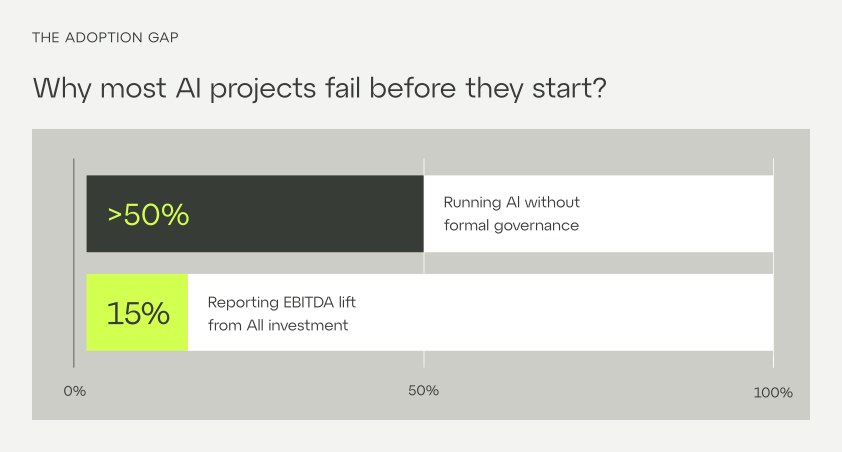
Three years after generative AI exploded onto the enterprise agenda, the numbers should look better than they do. Most large organisations are now running AI in at least one function. Very few are scaling it across the business. And fewer still are seeing it show up in financial results. Only 15% of AI decision-makers reported an EBITDA lift from their investment in the past year, according to Forrester's 2026 research.
Something is going wrong. The question is where.
The instinct is to look at the technology – the wrong model, the wrong use case, the wrong vendor. But that is rarely the problem. Most enterprise AI programmes that fail do not fail in deployment. They fail earlier, in the preparation phase, before a single line of code is written, before a vendor is chosen, before a pilot is launched.
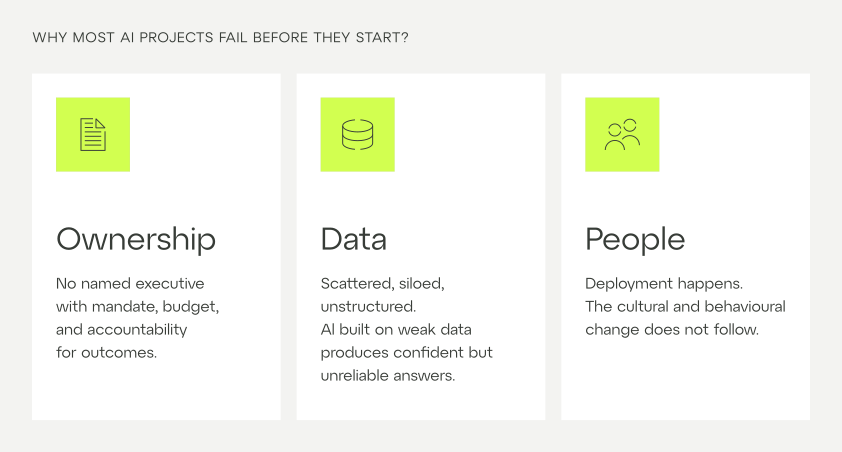
Three failure modes account for the vast majority of AI investment that does not deliver.
Nobody owns it
AI initiatives are often launched with enthusiasm but without clarity. A CIO initiates a pilot. The CHRO gets involved when training is mentioned. The CDO raises data questions. The CEO is broadly supportive. Nobody has a clear mandate to decide what gets built, how fast, and at whose expense.
More than half of department-level AI initiatives are running without formal approval or oversight, according to EY's 2026 survey of technology executives. That is not just a governance risk. It signals that most organisations have not answered the fundamental question of who is accountable for AI outcomes. Without that accountability, programmes drift. Budgets get consumed by pilots that never scale. Decisions get made by default rather than design.
Leadership alignment is the single most reliable predictor of whether an AI programme gets past the pilot stage. Most programme failures trace back to the same root: no executive who genuinely owned the outcome.
Good AI readiness starts with ownership. Not a committee, not a working group – a named person or small team with a mandate, a budget, and clear accountability for delivery.
The data is not ready
Most enterprise AI programmes discover their data problems after they have started building, which is the most expensive time to find them. Documents stored in systems untouched for years. Data siloed across platforms that do not speak to each other. No consistent metadata, no taxonomy, no clear picture of what the organisation actually knows or where it lives.
The quality of an AI system's outputs is almost entirely determined by the quality and structure of the information it can access. A well-configured AI sitting on poorly organised data will produce confident-sounding, unreliable answers. Unreliable answers are worse than no answers: they erode the trust that adoption depends on.
The data foundation question is not purely technical. It is a governance question: who owns enterprise knowledge? Who decides what gets structured, indexed, and made available? Answering those questions before building saves significant cost and rework later.
Nobody prepared the people
The most consistent finding across organisations that have tried and struggled with AI is this: the technology rarely fails. The people side does – resistance from employees who do not understand why they are being asked to change. Managers who have not modelled new behaviours themselves. A culture that has not created the psychological safety needed for experimentation. None of this gets fixed by a training session two weeks before go-live.
The gap between AI being available and AI being genuinely used is almost always a people gap. Research consistently shows that human factors - resistance, skill gaps, low confidence – are the primary challenge in AI implementation, not the tools themselves. Organisations that invest in adoption capability before deployment consistently outperform those that treat people change as a communication task.
The difference shows up first in usage data, and eventually in business results.
What readiness actually looks like
An organisation genuinely ready to build and deploy AI has three things in place before a vendor is engaged: a named owner with a mandate, an honest audit of their data landscape, and a change plan that starts at the leadership level.
None of these are exotic. None require significant upfront investment. But they are the preconditions that most organisations skip - either because they are impatient to show progress, or because they believe the technology will do more of the work than it actually will.
Moving fast without governance does not accelerate value. It creates liability and erodes confidence. The organisations seeing real returns from AI are not the ones who moved fastest. They are the ones who prepared well before they moved at all.
Where to start
The most valuable first step is not a technology selection. It is an honest assessment: where does accountability sit? What data do we have, and is it in a state that AI can use? Are our leaders ready to model the change they are asking their people to make?
Those three questions, answered honestly, determine more about whether an AI programme delivers than the choice of model or platform. Start there.
About the author

Phillip Ørbæk
Director of AI and Digital
Phillip Ørbæk is AI & Digital Director at emagine, working on both how the company adopts AI itself and how it helps clients do the same. Over a decade spanning marketing, digital experience, technology and platform delivery has left him with one fairly narrow conviction – the technology is rarely the constraint, adoption is. He is passionate about turning ambition into something people genuinely use – and stripping out the complexity that usually stops it happening.