
A Sept. 29, 2026 emagine roundtable event in London revealed that many stakeholders to the adoption of AI within the operational landscape of commercial and investment banking institutions are now increasingly interested in measuring the value of the technology in ways that hold up to boardroom scrutiny.
To that end, a review of academic- and industry-produced research and statements produced over the last 12 to 18 months shows that reported financial value for the use of AI tools in back-office and in enterprise procurement operations exists, but it is not yet agent-specific on a net-return basis. For example, Banco Santander cited EUR 35mn of AI-related “business value” generated in Q1 2026, in a June 2026 statement and in its prior earnings statement; however, those disclosures do not allocate the ascribed economic value to autonomous back-office agents or to procurement, nor do they provide a corresponding investment and ongoing-cost denominator.
Simply put, the global banking and financial services industry has yet to coalesce around an industry standard calculation for the return on investment associated with AI-related implementation and integration costs, and thus it arguably still lacks an understanding of the financial implications associated with further adoption of the technology.
However, in arenas such as back-office operations and enterprise procurement, the industry may be getting closer to documenting the data points necessary to one-day agree on a commonly accessible AI-spending and ROI assessment standard. This article reviews some of the research available in 2026 supporting this hypothesis.
From Task Automation to Agentic Orchestration
Traditional Robotic Process Automation (RPA) delivered vital initial productivity gains across banking operations by automating structured, rule-based tasks. However, as transaction volumes surged and regulatory requirements intensified, legacy RPA script maintenance hit a cognitive ceiling when confronted with unstructured documents, ambiguous vendor inputs or complex multi-system exception handling, according to a November 2025 study produced by three Aktif Investment Bank employees for The Eurasia Proceedings of Educational and Social Sciences (EPESS) journal.
As financial institutions face diminishing returns from incremental enterprise resource planning (ERP) upgrades, forward-looking enterprise leaders are pivoting toward autonomous AI agents and intelligent orchestration fabrics, according to a Bain & Co. April 2026 report. In commercial and investment banking – where back-office workflows routinely consume up to 70% of total operational effort – transitioning from task automation to end-to-end autonomous business logic represents a pivotal strategic inflection point.
For IT and operations executives navigating strict compliance frameworks and disciplined capital allocation, separating empirical field evidence from vendor marketing hype is critical. Instead, emagine believes that examining live production deployments across global banking groups provides clear visibility into where autonomous agents deliver measurable operational performance – and where the financial ROI calculation demands rigorous scrutiny.
Empirical Field Evidence: Operational Breakthroughs in Banking
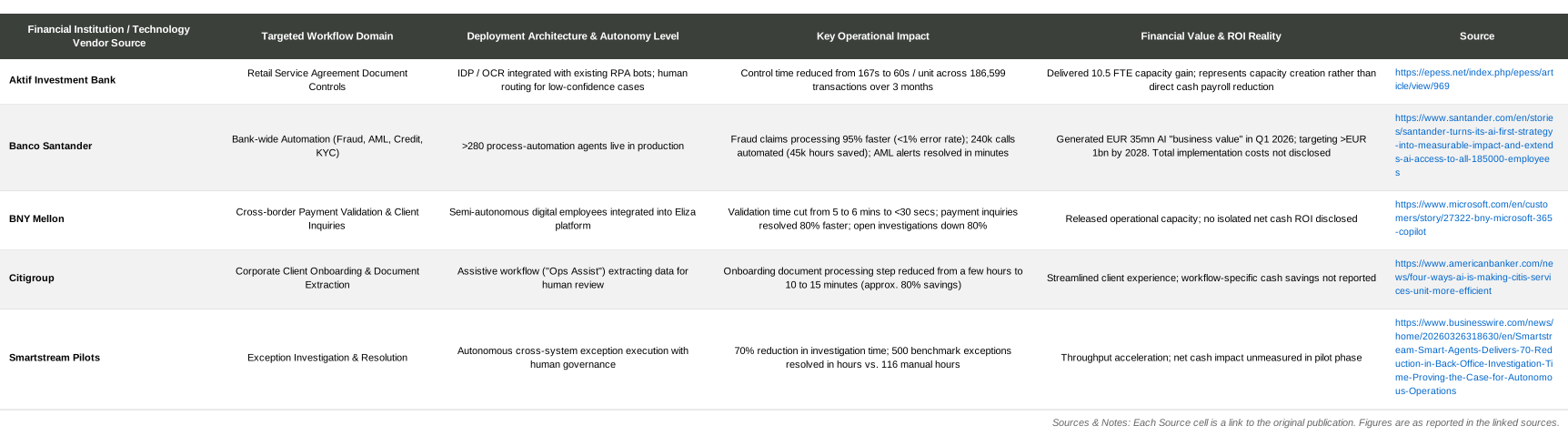
A review of publicly available research shows that field data from four CIBs and one technology vendor confirms that bounded, supervised AI agents achieved significant operational breakthroughs across core back-office functions, including payment repair, investigation handling and document processing over the course of several recent deployments (see Figure 1).
Automated Procurement: Transforming Source-to-Pay (S2P) Cycles
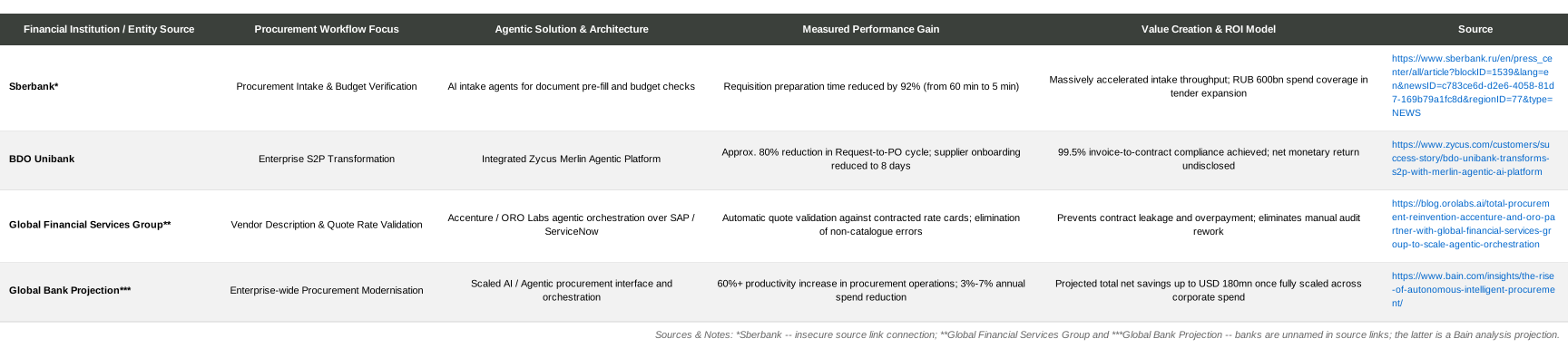
In enterprise procurement and S2P workflows, administrative bottlenecks directly impede organisational speed and contract compliance. Bounded autonomous agents are increasingly deployed to orchestrate complex intake, quote verification and vendor management (see Figure 2).
Evaluating the ROI Reality: Capacity Release vs. Financial Conversion
While task-level velocity improvements are unquestionable, translating operational speed into a defensible financial ROI requires strict analytical discipline. emagine believes that enterprise IT leaders must navigate three key economic distinctions when building business cases for autonomous agents:
- Capacity Release vs. Cash Realisation – Public disclosures routinely highlight released capacity (e.g., hours saved or FTE equivalents) rather than net cash ROI. Released capacity only converts to hard financial return when it enables a bank to reduce contractor spend, eliminate overtime, or absorb higher transaction volumes without increasing headcount;
- Fully Loaded Cost Accounting (Total Cost of Ownership) – A defensible ROI model must offset operational gains against total incremental costs – including data remediation, system integration, API usage licensing, model inference costs, continuous audit logging and human exception handling infrastructure; and
- Bounded vs. Unconstrained Autonomy – Field evidence strongly validates bounded, supervised agentic workflows (e.g., draft generation, rule validation, exception routing). Unconstrained autonomous purchasing or unmonitored transaction settlement remains commercially unproven and introduces unacceptable regulatory risk under European compliance frameworks.
Key Strategic Takeaways for Enterprise IT Leaders
For senior technology decision makers framing enterprise AI agent strategies, real-world field data yields four actionable recommendations:
- Target Bounded, High-Friction Bottlenecks First – Prioritise agentic deployment on structured, high-volume operational bottlenecks with well-defined rule sets such as cross-border payment exception repair, client onboarding document verification and vendor rate card validation;
- Layer Orchestration Over Legacy Core Infrastructure – Avoid high-risk, multi-year ‘rip-and-replace’ overhauls of legacy core banking or ERP platforms. Instead, deploy modular agentic orchestration layers that integrate existing mainframes, SAP and ServiceNow instances via secure, managed APIs;
- Rigorously Separate Capacity Release from Direct Cash ROI – Mandate that finance and transformation teams track operational throughput gains separately from cash savings. Require concrete verification of reduced overtime, lower contingent workforce spend or avoided hiring before claiming net financial returns; and
- Embed Human-in-the-Loop Governance by Design – Ensure every autonomous workflow incorporates explicit confidence scoring, comprehensive audit logging and automated escalation pathways to human specialists for low-confidence or high-value exceptions.
Toward Accountable Autonomy: How Agentic Banking Operations May Mature by 2029
The evidence reviewed in this article points to a sector that is moving past proving that autonomous agents work and now must prove what they are worth. The operational record is already substantial. Reported gains include fraud claims processed 95% faster at Banco Santander, a 92% reduction in requisition preparation time at Sberbank and investigation times cut by 70% in the Smartstream pilots. Yet most of these disclosures describe released capacity, not net cash return. Over the next one to three years, the most probable development is that this gap closes.
Three shifts appear likely in the short-to-medium term. Specifically:
- Financial Measurement May Converge on a Common Standard – As institutions are pressed to show returns that withstand boardroom scrutiny, the field data suggests that capacity release, fully loaded cost and verified cash savings will increasingly be reported separately. Santander's stated target of more than EUR 1bn in AI-related business value by 2028 will test whether such disclosures can be reconciled with implementation costs;
- Bounded Autonomy is Likely to Widen, not Disappear – Supervised agents with confidence scoring, audit logging and escalation to human specialists have produced the strongest results to date. Autonomy will plausibly extend to adjacent workflows, such as payment repair, onboarding and vendor validation, while remaining within European compliance frameworks; and
- Orchestration Layers may Replace Point Automation – Projections such as the Bain analysis, which suggests savings of up to USD 180mn once procurement is fully scaled, depend on coordinating agents across existing platforms, not on isolated pilots.
Taken together, the near-term competitive advantage is unlikely to rest on deploying agents first. It will rest on demonstrating, with auditable evidence, that autonomy delivers measurable and governable value.